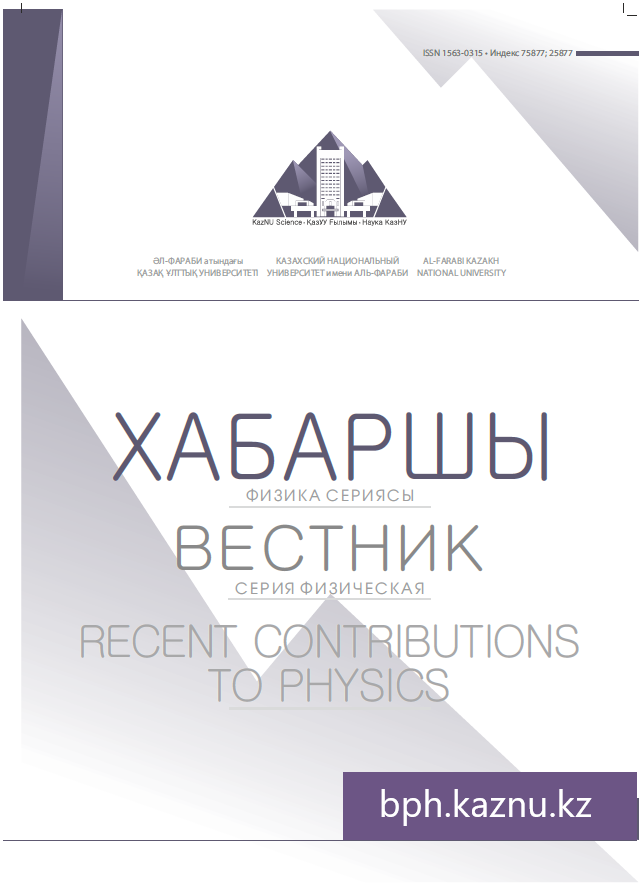
The Journal Recent Contributions to Physics (Rec.Contr.Phys.) was founded in 1992. The founder and publisher of the journal is Al-Farabi Kazakh National University.
The Recent Contributions to Physics is a peer-reviewed open-access journal dedicated to the publication of significant research in the field of physical sciences and the methodology of physics education in higher education institutions. It serves as a global platform for researchers, scholars, and professionals to present innovative theoretical, computational, and experimental studies that contribute to the advancement of knowledge in the physical sciences. The journal is published four times a year.
The journal publishes original research articles and review papers that expand the understanding of fundamental principles of physical models and experimental methods across various branches of physics. The journal adheres to high standards of peer review, rigorous editorial requirements, and a strong commitment to open access to knowledge, ensuring the accessibility and integrity of published research.
Peer-review process:
Initial editorial screening: approximately 2 weeks
Peer-review policy: Double-blind peer review
Average review time: 4–12 weeks
Acceptance rate: 38%
Indexing and Abstracting
Clarivate Web of Science
Crossref
Science Index
Academic Resource Index (ResearchBib)
DOAJ
ROAD
Wikidata
SUDOC
CiteFactor
Committee for Quality Assurance in Science and Higher Education of the Ministry of Science and Higher Education of the Republic of Kazakhstan
EZB
Aims and Scope
The Recent Contributions to Physics is a peer-reviewed academic publication dedicated to presenting cutting-edge research in the field of physics. Its main goal is to provide an international platform for researchers, academicians, and practitioners to share original research articles and high-quality review papers that contribute to the advancement of both fundamental and applied physics. The journal welcomes manuscripts that address a broad range of topics, with a focus on emerging theories, interdisciplinary approaches, and practical applications in science and industry.
Articles are published in the following subject areas:
✔ Theoretical physics
✔ Nuclear and particle physics
✔ Astrophysics
✔ Plasma physics
✔ Condensed matter physics and materials science
✔ Nanoscience
✔ Thermal physics and theoretical heat engineering
✔ Nonlinear physics
✔ Radiophysics
✔ Issues of physics education in higher education
Why Publish in Recent Contributions to Physics?
Compliance with international publishing standards – the journal follows the recommendations of COPE, ICMJE, and the principles of academic integrity, including transparency in peer review and editorial policies.
International editorial board – composed of experts from different countries, ensuring a diverse and high-quality peer-review process.
Rigorous peer-review system – double-blind peer review involving at least two independent reviewers for each manuscript.
Creative Commons licensing – articles are published under a Creative Commons license, allowing free dissemination and reuse of research results with proper attribution.
DOI assignment – all published articles receive a unique Digital Object Identifier (DOI), ensuring accurate citation and long-term accessibility.
Open Access model – Gold Open Access with an Article Processing Charge (APC) of 60,000 ₸; all articles are freely available online immediately after publication.
Plagiarism screening – all manuscripts undergo mandatory plagiarism checks using specialized software prior to acceptance.
Author support – editorial assistance with manuscript preparation in accordance with international standards (IMRaD structure, references, metadata).
Open scientific communication – free access to full-text articles enhances citation potential and research visibility.
Digital archiving – long-term preservation of all published content in reliable digital repositories.
The journal is committed to advancing both theoretical and applied knowledge in physics and encourages research that bridges the gap between fundamental science and practical technological advancements, aiming to make a significant impact on both scientific communities and industry practices.